It is a firm belief of mine, proven time and again, that the best way to learn about the land is from the perspective of water.
Be it snorkeling off the mangrove forest-lined shores of Danjugan Island in the Philippines, passing rice paddies on sampan boats on Vietnam’s Ngo Dong River, or marveling at the multi-colored harbor of Tobermory in Scotland’s Mull (even being submerged in the contemplative shallows of a bathtub), the perspective from the water offers the distance needed to see the full picture.
I was proven right yet again in April of this year on a trip to Tasmania to visit the pioneering whisky brand of this small but mighty Australian state, Lark Distillery. Setting sail from capital Hobart’s historic Constitution Dock – Mount Wellington looming in the background – and heading south down the River Derwent, views from our boat’s port-side are lush, flat, and green with verdant hop fields, while to our starboard are brutally rugged cliffs, coarse bushlands, and secluded, sandy beaches.
Seeing the island from this specific perspective, it’s even more compelling to imagine how Lark Distillery began its life as the first legal whisky maker in Tasmania in over 150 years.
Land Before Time
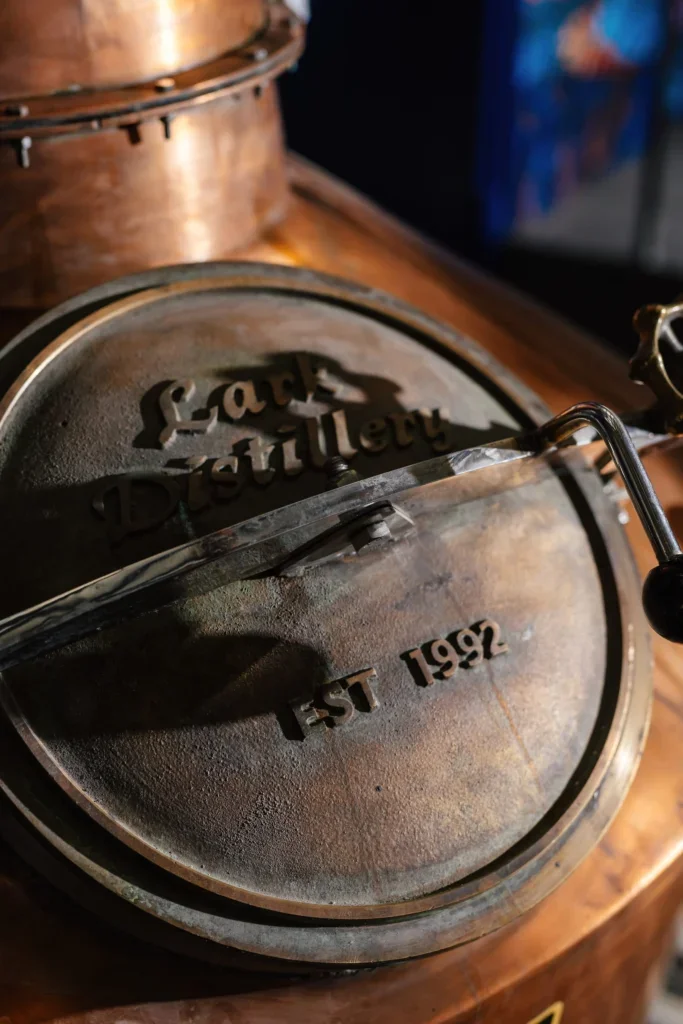
Founded by Bill and Lyn Lark in 1992, its story also began, maybe not so coincidentally, on the water, when Bill was fishing on Lake Sorell in the highlands with his father-in-law. In the stillness, surrounded by grassy woodlands and marshes, and beneath the vast expanse of the sky above them, the seed of making a single malt whisky that could capture the very essence of Tasmania’s terroir was planted.
On paper, this pocket of the world is the perfect place to make whisky. With some of the purest waterways and cleanest air in the world, as well as diverse soil structures, homegrown barley, ancient peat bogs and polarizing weather shifts, it’s hard to believe that no one had made commercial whisky in Tasmania since 1839. But when Governor John Franklin prohibited distillation in that year, halting the progress of 16 legal distilleries, it would take just over 150 years for the island to be known for whisky-making again, thanks to the overturning of those laws by the Larks.
Now, over three decades later, Lark Distillery, while considered the doyenne of the Tasmanian industry, has catapulted the island onto the international whisky map, with Tasmania now home to the most distilleries of any state in Australia. It takes tenacity, dogged determination and that soupçon of madness that I’m convinced all whisky distillery owners possess to start a movement from nothing.
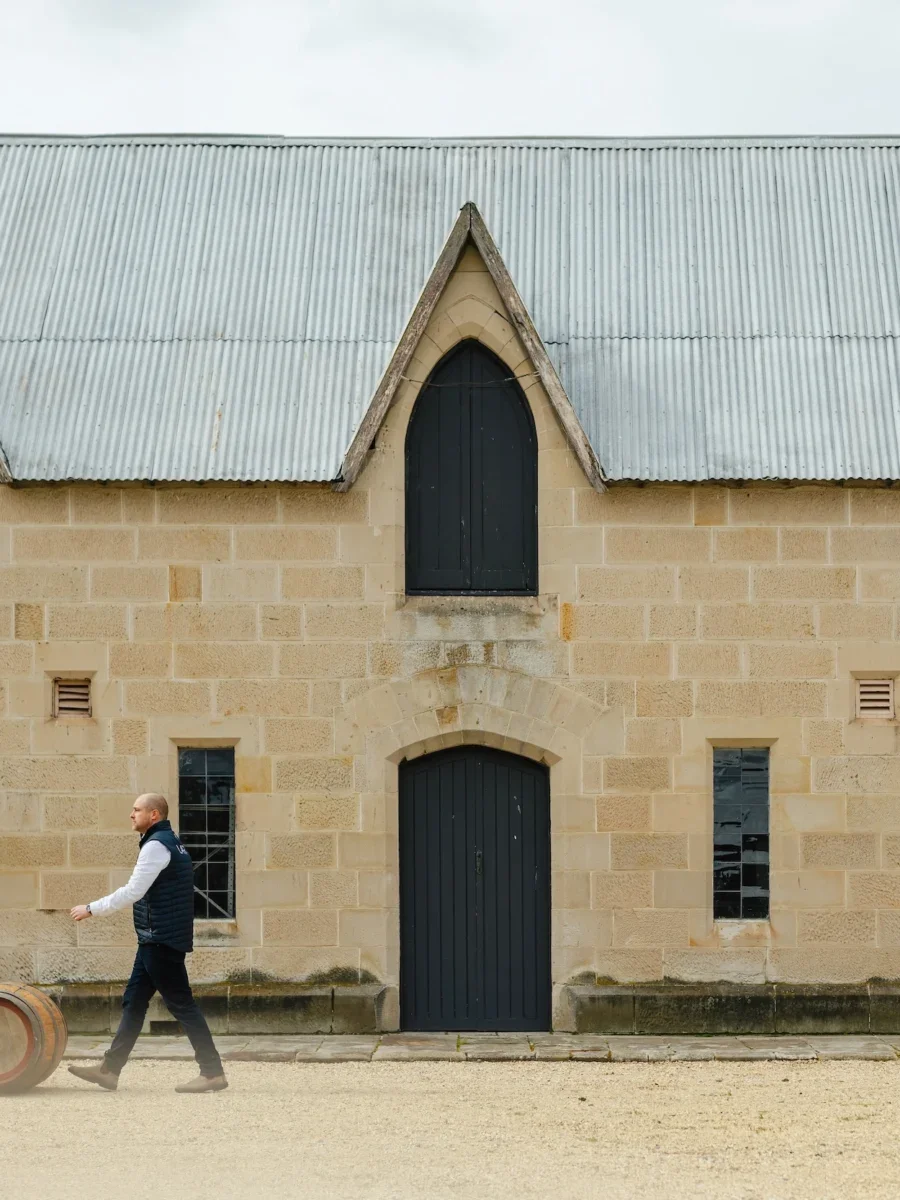
As I arrive at its 40-acre Pontville distillery, acquired as part of its 2021 expansion, just 30-minutes from Hobart and set in a series of imposing and reverently restored 1800s buildings, I’m about to discover just how that mindset has trickled down into one of the most dynamic teams I’ve met in my career, and, ultimately, into their whisky.
Pioneering Perseverance
Distillery experiences don’t usually begin with a morning meeting, but no sooner had I arrived and taken a breath of that famously clean, crisp air, master distiller Chris Thomson whisked me into the office for a glimpse into how a day making Lark single malt whisky begins.
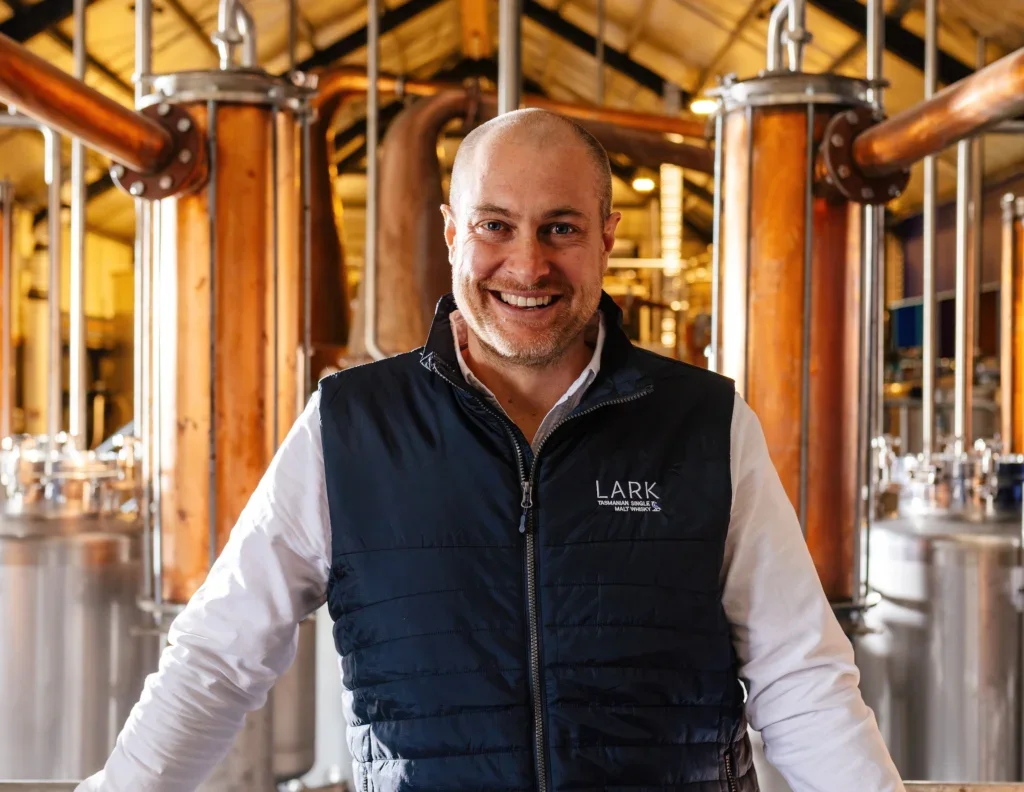
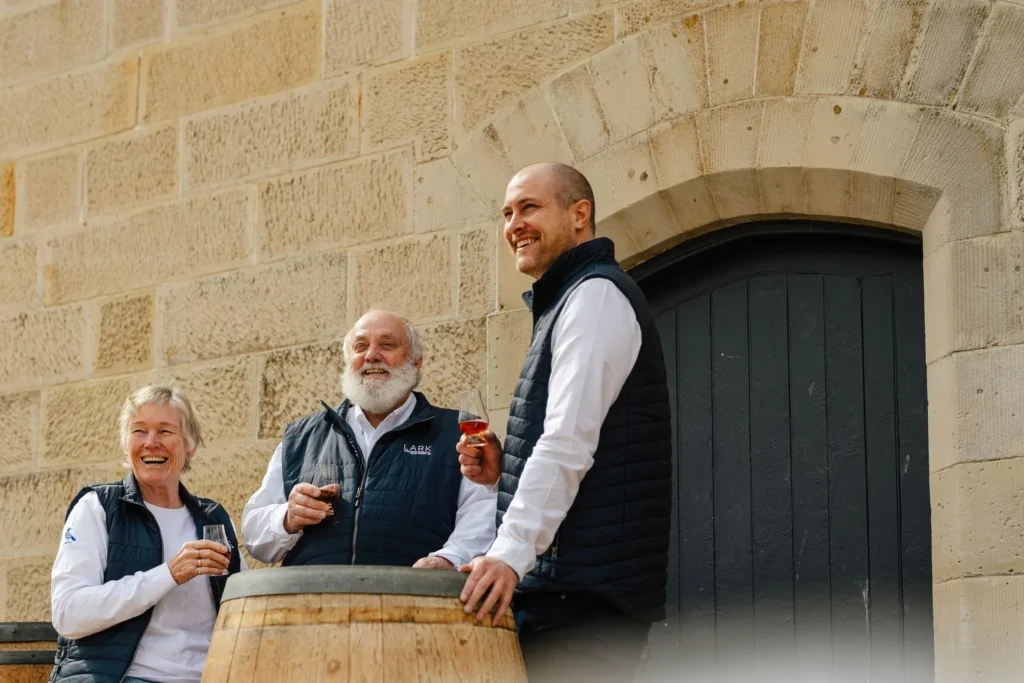
A former musician, Thomson came to Lark in his early 20s. Under the mentorship of Bill and the technical tutelage of Lyn, he rose from apprentice to his current role in 2010. Although Bill and Lyn’s hands are still gently on the tiller, Thomson masterfully steers the ship with an abundance of character. He’s toweringly tall but in no way imposing, highly energetic but simultaneously laser-focused, honed in his craft but hungry for challenge. His interrogation of everything they do at Lark is a constant curiosity bubbling beneath the surface.
He has built a team that feels fully in-tune with his ethos, while individually allowed to flourish, too. On my visit, I spend most of my day (and, later, an evening at Hobart’s Irish pub New Sydney Hotel) with a gang of likeminded-souls: distillery manager Jake Evans who carries all of Lark’s myriad recipes on calm and confident shoulders; Josh Wilson, senior whisky blender, a sensory-sensei and second-in-command to Thomson; Niall Maurici, brand experience manager and my one-man Encyclopedia to Tasmanian history; Nicholas Walden, blender and the endearingly deadpan keeper of their ‘Whisky Bible’ (inventory record); and Greig Ewen, humble head of production and a former engineer who gently and figuratively holds my hands – and spills quite a bit of new make on them – during a very special tasting (more on that to come).
After coffee orders, quite a lot of piss-taking and music requests to soundtrack the day (Thomson’s team speak as fluently in melodies as they do whisky), I’m taken on a tour of the production facilities that bring Lark’s spirit to life.
It would be easy for me at this point to take you through a painstakingly formulaic, detailed step-by-step of how Lark whisky is made. I could tell you that they are the only whisky distillery with their own peat mining license, taking peat from Brown Marshes in the central highlands and integrating its medicinal and earthy character deftly into the background of its single malt’s profile; that they use barley malted in Devonport, which imparts an oily and viscous texture, and cut their whisky with water smoked using applewood from the Tasmanian Apple Isle.
I could spend paragraphs on the fact that they allow for open fermentation (which can last from seven to 14 days) and encourage bacterial influence and acidity. They don’t do caustic cleaning for more diversity of flavor and use smaller stills to ramp up that viscosity. They take their second cut particularly late, based on taste alone.
A New Perspective
All fascinating stuff, and central to the story of Lark single malt whisky. But during my day with Thomson and his band of merry makers, what really anchored every ‘a-ha’ moment of my day (of which there were many) was not the process of how they make whisky, but the perspective from which they are making it. One which celebrates variability over consistency, evolution over staticity, and informed freedom over (what Thomson deems) egotistical control: a breaking and rebuilding of the framework around which whisky is made, into something more rhythmic, driven by instinct.
I got to experience this approach first-hand when – for the first time in my career – I was given control of making that all-important second cut. Having seen this process happen from behind the confines of a spirits safe countless times, to be tasked with tasting spirit off the still and making that call gave me a whole new respect for what these often quiet, solitary workers in distilleries do.
While a rather bemused tour group was being put through the paces of a working distillery, Thomson handed me the reins and (quietly) tasted new make spirit alongside me across three unpeated runs for over an hour while The Mars Volta (one of our mutual favorite bands) pumped out over the speakers. I’ve tasted plenty of new make spirit in my career (it’s one of my favorite pastimes), but I’ve never experienced a spirit changing so drastically in the time it takes to taste, spit, and ask for another sample. (Even the difference between making a cut call and turning the lever can be dramatic.)
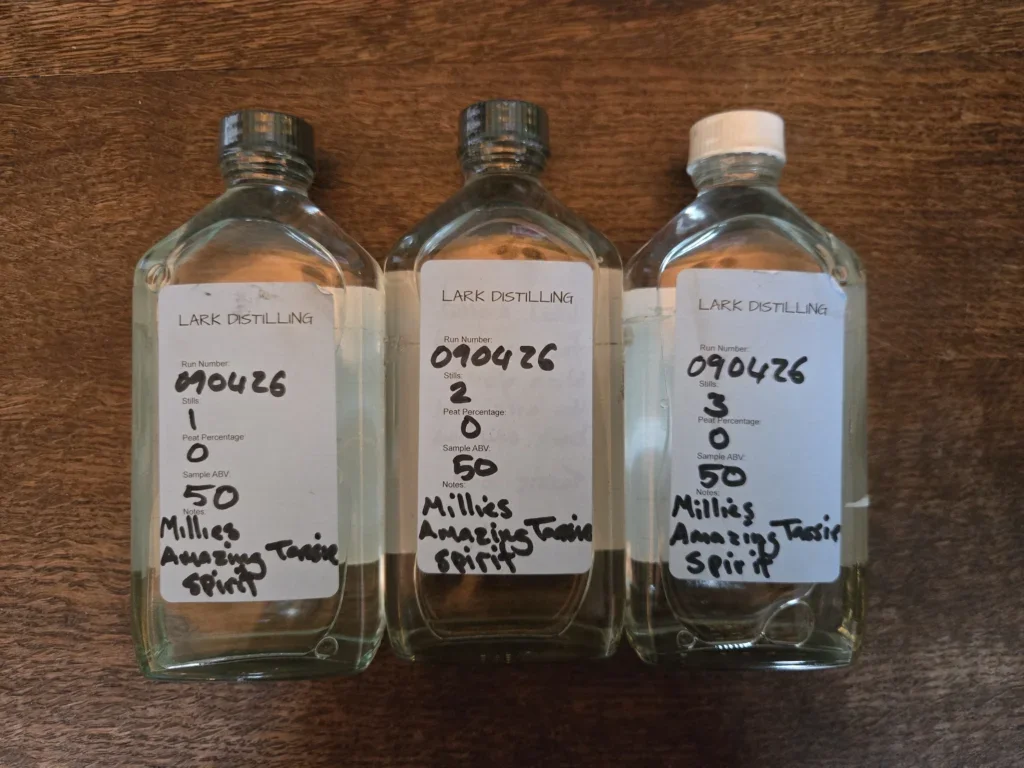
As my hair slowly started to stand on end, I moved through the three runs and unearthed chocolate orange, waxy cereal, fruit salad sweets, Turkish delight, slate, minerality, petrichor, bitterness, pine resin, forest floor, mud, and moreish viscosity. Every millisecond stretched the spirit in unexpected ways, both in terms of taste and texture – pop, lift, depth and angles all revealed themselves. A Wonka-esque Everchanging Gobstopper, if you will.
In that first 20 minutes, I looked for Thomson’s approval – which was not forthcoming – for when to pull the trigger. But as we moved through the runs, I slowly but surely gained the confidence to push later, wait longer, be patient. What revealed itself over time was, of course, the character of spirit, but also my own interpretation of it.
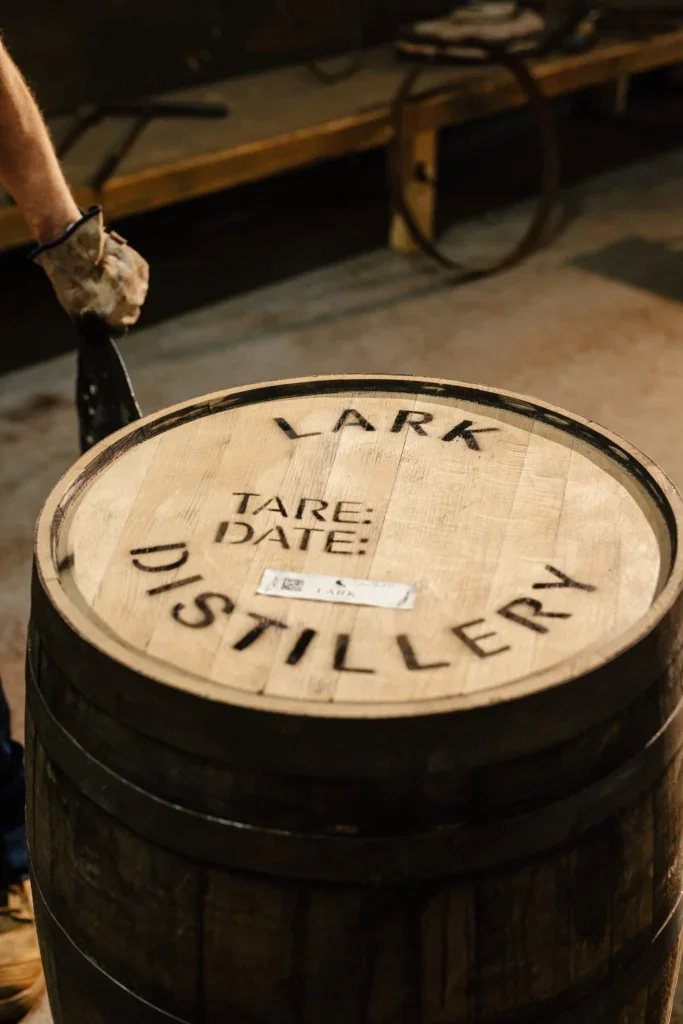
While I had the luxury of traveling wide-eyed and dopamine-filled through the new make process, the Lark team must also keep the next stage of this liquid’s journey front of mind. They own the only on-site cooperage in Tasmania, meaning they can combine the likes of Australian PX, Apera Sherry, and Muscadelle casks. They also work exclusively with Seppeltsfield in the Barossa Valley, using its fortified wine casks to age its single malt, some of which have held wine for over a century.
“For all the technical brilliance that happens within this distillery, what matters most to Thomson is the input of people and their interpretation of what Tasmanian whisky is.”
Millie Milliken
What exactly happened to my three new makes, I don’t know. There were whispers of convincing the boss to put them in something special, but what I do know is that it will be the usual balancing act with the deeply sweet influence that those fortified wine casks have on Lark’s spirit, not to mention the huge swings in temperature year-round (or even in a day, as I experienced) in the warehouses. Perhaps they’ll even meet a finish like a Chinotto citrus, ex-bourbon, muscat or American oak cask. Time, and perhaps another trip to Tassie, will tell.
People and Place
Thomson encourages diversity of his people, and this was my own initiation into that philosophy. For all the technical brilliance that happens within this distillery, what matters most to Thomson is the input of people and their interpretation of what Tasmanian whisky is.
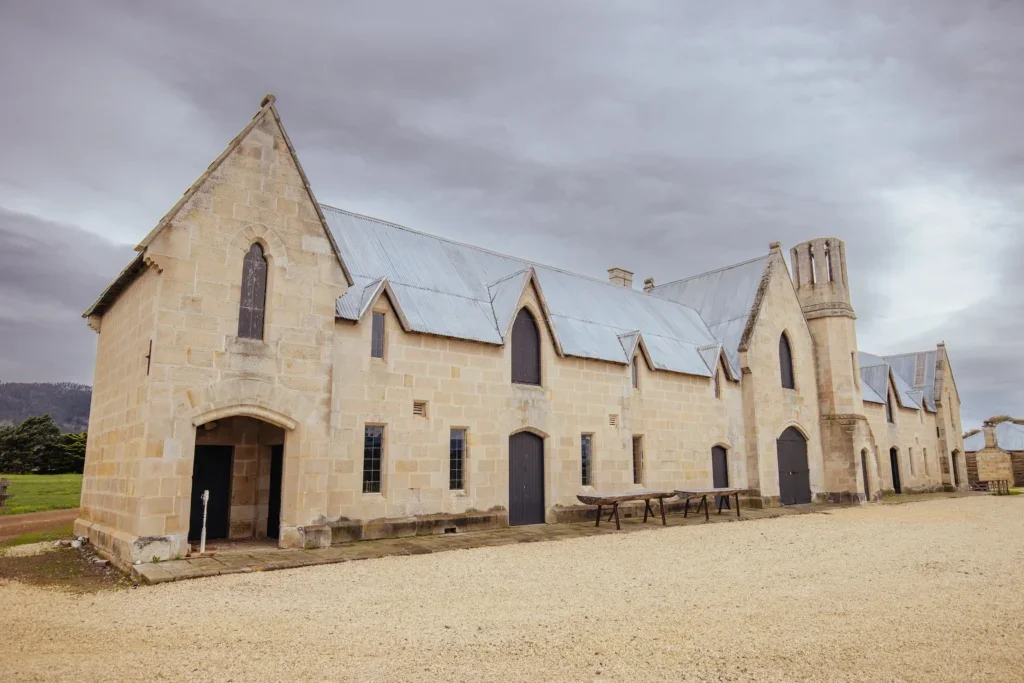
Throughout my time in Tassie, the ‘convict mentality’ is mentioned proudly and progressively. Tasmania’s indigenous history and its bloody time as a British penal colony are, rightly, never far from the conversation. Indeed, the distillery itself is part of what was once the Shene Estate, a Gothic Revival-style colonial building that is a visual reminder of those dark times.
Yet it has given this whisky-making nation a specific and spirited outlook on what they want Tasmanian whisky to be. Something that, while recognizing the craft of its forebears such as Scotch (Bill and Thomson talk of the category reverently), speaks of this specific hallowed land, the unique origins of its people, and a legacy that now they can freely write. Making whisky at Lark is the mission, but translating their perspective is everything.