What does value mean in today’s Scotch market, and, more pertinently, is it coming back?
It’s a question that has quietly evolved alongside the industry itself. For years, value was shorthand for age statements and familiar names. More recently, it’s been tangled up with scarcity narratives, lavish pack design, and prices that seem to levitate beyond logic. But as the Scotch whisky industry finds itself sitting atop a vast, silent reserve of maturing spirit, the definition of value may be shifting back toward the drinker.
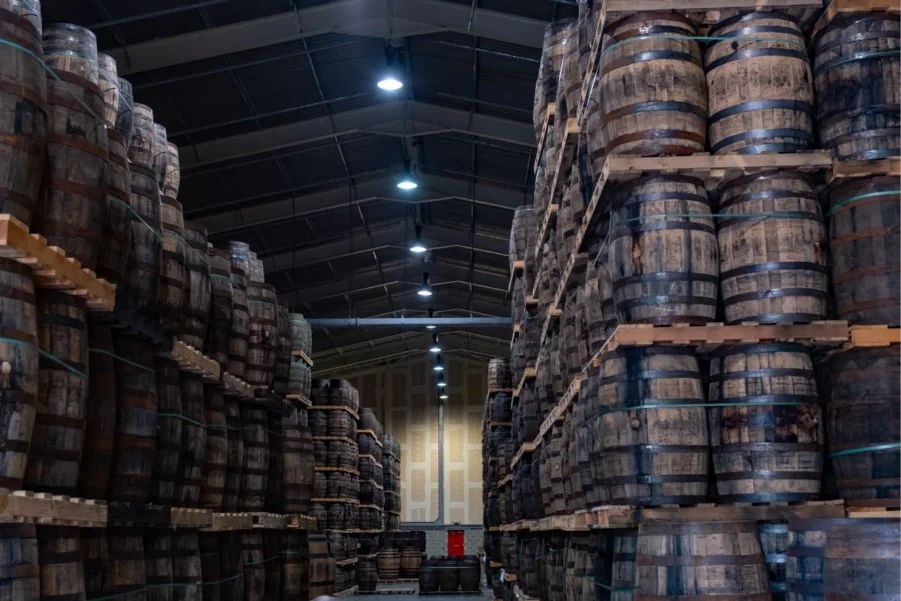
According to a report in the Financial Times last month, five of the distilling giants (Diageo, Pernod Ricard, Rémy Cointreau, Campari, and Brown-Forman) collectively hold an estimated $22 billion worth of maturing spirit in casks, including Scotch, Irish whiskey, cognac, and tequila.
That figure is staggering not only in absolute terms, but in what it represents: millions of casks quietly breathing away in warehouses from Speyside to Jalisco, tying up capital, demanding attention, and patiently accruing both flavor and cost. For the consumer, though, this “lake of spirits” – particularly Scotch whisky – raises a tantalizing possibility: Could this translate into better value for money for us, the consumers?
To understand why it might, we need to appreciate the financial weight of stock on this scale. Maturing whisky is not cash in the bank; it is profit in deep stasis.
“In an era of higher interest rates and more cautious lending, holding vast inventories becomes an increasingly expensive luxury. At some point, that spirit must be sold.”
Neil Ridley
Distilleries must fund insurance, warehousing, and maintenance, and report evaporation loss to the taxman. The simple fact is that every dollar locked into spirit is a dollar not available for other investments. In an era of higher interest rates and more cautious lending, holding vast inventories becomes an increasingly expensive luxury. At some point, that spirit must be sold.
This is where value, in the truest sense, begins to reassert itself. Not value as a marketing term, but value as a relationship between quality, price, and availability. If distilleries are incentivised to move stock, particularly well-matured stock earmarked for core ranges, then the opportunity exists for consumers to see age statements stabilize, bottle prices soften, or quality quietly improve without fanfare.
It’s worth remembering how we arrived here. Roughly a decade ago, Scotch whisky was riding a wave of optimism. Demand from emerging markets appeared insatiable. Distilleries such as Glenfiddich and The Glenlivet embarked on major expansion programs, increasing production capacity and warehouse space to supply growing thirsts for Scotch in China, Russia, India, and South America. The mood was bullish, the spreadsheets confident. Scotch, it seemed, was unstoppable.

Then reality intervened. Economic cycles turned, geopolitical tensions reshaped trade, and the Covid pandemic delivered a global shock to hospitality and travel retail – two pillars of premium whisky sales. At the same time, a younger generation of drinkers began exploring spirits through a different lens. Tequila and mezcal, with their punchy flavors and cocktail-friendly credentials, surged in popularity, while Scotch, often perceived as formal, expensive, and old-fashioned, struggled to command the same cultural oxygen.
And yet, this is far from the first time spirits have faced an oversupply reckoning. History is littered with such moments. The infamous Pattison Crash of 1898 remains the most dramatic early example, when reckless speculation and dubious accounting practices led to widespread collapse and forced the industry to retrench and lick its wounds for nigh on five decades.
The 1980s and 1990s is another painful memory for distillers, with closures, mothballing, and job losses rife, as producers grappled with declining demand and excess stock. The effects were felt for decades as lower revenues cascaded into poorer products.

“In times where cash flow is tight, the quality of wood goes down,” explains industry retailing and bottling legend, Sukhinder Singh. “I’ve seen this before in the 1980s. If you go back to the 1990s, a 12-year-old whisky was of shocking quality. However, during the 2000s, there were much better casks being used and most [of today’s] big distilleries have some decent, well-padded cask inventories, so I think this time, we’re going to be ok.”
So, where does that leave value for money in practical terms? It begins with core ranges: the reliable 10-, 12-, and 15-year-old releases that form the backbone of most distillery portfolios. We’re unlikely to see significant price reductions to existing products, but value will come in through new additions.
The Macallan has clearly taken note. It’s new 12 Year Old 110 Proof (£125/$125) offers remarkable value compared to the standard Sherry Oak 12 Year Old (£95/$110). Ardbeg is also in on the act: it has bottled a cask strength version of its 10 Year Old (£75/$90) at a punchy 61.7% ABV, albeit as a limited edition. These high-strength releases aren’t just gifts to the consumer; they also shift more aged stock out of already bloated warehouses, converting depreciating assets into hard numbers on the balance sheet.
In the end, value for money is not about cheapness, but fairness. It is about knowing that what’s in the glass reflects not only years in cask, but respect for the person pouring it. With all that stock patiently waiting in the wings, the spirits industry has a rare opportunity to prove that its greatest asset isn’t scarcity at all, but trust.