The question of how our Tasting Panel should score spirits has required proper research and hard thinking.
How do you design a system that readers recognize immediately yet works across the full range of the spirits world?
There isn’t a single correct answer, but we’ve drawn on the accumulated experience of our Tasting Panel to build a methodology that delivers consistent results and gives readers a clear guide to the finest spirits in the world. Transparency is central to that aim, and this article explains exactly how our scoring methodology works.
Open tastings
We also place clear value on open tastings, where the spirit’s identity is known in advance. Where blind tastings provide depth, open tastings allow us to provide breadth. It also allows our Tasting Panel to assess spirits in a context closer to real-world consumption.
For open tastings, contributors must declare the source and size of the sample and submit their notes simultaneously via the Tasting Notes portal, mirroring the discipline of controlled sessions.
While the format is less restrictive than blind tasting, standards of disclosure, consistency and attribution remain the same. Tasters must recreate controlled conditions as closely as possible by tasting the sample in similar glassware with a cleansed palate. Above all else, our tasters must apply a consistent and methodical approach to the evaluation of each sample.
Blind tastings
Not every spirit in the Tasting Notes library is assessed blind, and this is always stated clearly on the profile. Where blind tasting is used, we follow a single-blind protocol in which the identity of the distillery and/or bottler is concealed. Three tasters, typically one recognized specialist and two experienced generalists, assess the spirits independently, entering their notes and scores directly into the Tasting Notes portal.
To protect the integrity of the process, tasters do not confer, and scores or comments cannot be altered once submitted. Notes and scores are attributed individually and published in full. This approach preserves a distinct authorial voice while benefiting from a consistent expert panel, allowing informed differences of opinion to be expressed.
Tasting panel and protocol
Whatever the format, The World of Fine Spirits draws on a permanent panel of respected and experienced spirits tasters. The panel includes recognized specialists and long-standing industry figures, many of whom are acknowledged authorities in their fields. The panel is deliberately kept small to ensure consistency and regularity of contribution, allowing readers to become familiar with individual palates and critical perspectives over time.
We make every effort to source representative samples, most often requested directly from producers. Where a taster has a commercial or professional interest in a spirit, this is declared, and their notes and scores may be excluded, including in blind tastings. To minimize palate fatigue, we strictly limit the number of spirits assessed in a single session, considering style, strength and category. Samples are poured and assessed at the tasters’ own pace, typically over extended sessions rather than in compressed flights.
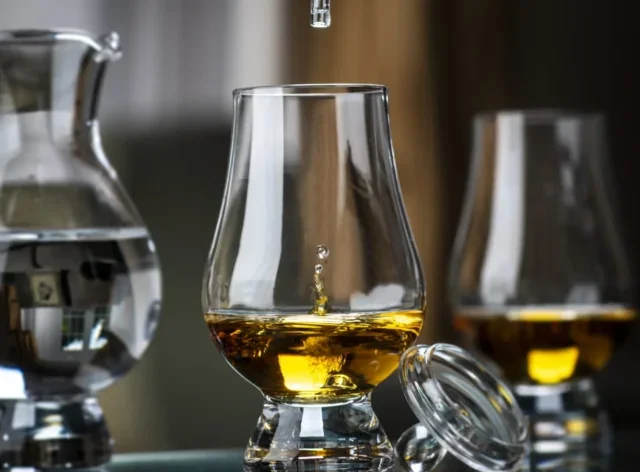
All our blind tastings use standard Glencairn whisky glasses or the equivalent.
100-point system
We use a 100-point system for all Tasting Notes. Originally adopted from wine media and popularized in spirits circles by Whisky Fun, it has since become common across publications and award panels. As with wine, we will rarely score anything below 70. Most spirits we publish will sit between 71 and 100, with anything under 70 considered flawed. Our scoring bands are defined as follows:
Exceptional (98–100)
Reserved for the rarest spirits that excel across all four areas of analysis. They show outstanding balance and complexity and have an additional quality that sets them apart.
Excellent (95–97)
A spirit that performs strongly across all four areas. It will be a standout example of its category, with a clear definition on the nose and palate and a long, evolving finish.
Distinguished (90–94)
A spirit showing good balance and complexity with a medium to long finish. A reliable benchmark for its category, offering the notes a seasoned drinker would expect.
Enjoyable (85–89)
A spirit that tastes as expected for its category and price. It hits the key notes and may offer a pleasant finish, though complexity will be limited.
Good (80–84)
A competent spirit with no major faults. It may lack depth or clarity, but it remains a fair representation of its type.
Below standard (71–79)
A spirit lacking balance, clarity or personality. Not overtly flawed, but short on execution and unlikely to meet expectations, particularly toward the lower end of this band.
Flawed (70 and below)
A spirit with noticeable faults or imbalances.
Areas of Analysis
The World of Fine Spirits Tasting Panel scores spirits on aroma, taste and finish, then adds an overall impression. The final score is the average of those four numbers, rounded in the usual way.
Most readers will be familiar with nose, palate, and finish. Overall impression is that we create room for the judgment that technical scoring alone can’t capture. A spirit can have an expressive nose, an interesting palate, and a long finish yet still feel disjointed. Overall impression is where tasters draw on their experience to decide whether the parts fit together and whether the spirit shows coherence, intent, and a sense of completeness.
Typicity also matters. A 50-year-old Scotch shouldn’t be assessed by the same expectations as a 5-year-old, even if some technical criteria overlap. Typicity asks whether the spirit is a credible example of its style and age, and that context is factored into the final score.
Nose
Complexity: Are there layers, or is it one-dimensional?
Character: Distinct aromas (orchard fruit, vanilla, peat, spice)?
Intensity: Pronounced or faint?
Balance: Are the aromas integrated, or is something dominant?
Palate
Flavor profile: Immediate flavors and how they evolve
Complexity: Number and interplay of flavor notes
Balance: Sweetness, acidity, bitterness, alcohol
Mouthfeel: Texture — light, creamy, oily, drying?
Alcohol integration: Well integrated or sharp?
Finish
Length: Short, medium, or long?
Quality: Clean, evolving, or unpleasant?
Complexity: Does it change or fade flatly?
Typicity
Does it deliver what it promises?
Does it reflect its category well?