
As any modern-day journalist will tell you, I get a lot of emails promising the next big thing.
They are almost always wrong, but that doesn’t necessarily mean they’re unworthy of investigation.
So when an email arrived in my inbox last month titled “Aged spirits in days, not decades,” it immediately piqued my interest. It claimed a technological breakthrough was about to upend the very foundations that have supported the spirits industry for centuries.
Naturally, I had to dig deeper.
The company in question, Reactory, believes it has mastered the art of accelerated aging in spirits – effectively an alchemic breakthrough that could lead to seismic changes in how we mature and consume different spirits. The New Zealand-based company, founded by Dr. Mark Eltom, has developed a high-tech system to re-create the key interactions between spirit, oak, and environmental conditions.
The technology comes with an impressive set of claims, chief among them that it can use any wood and any spirit to produce a 10-year-old spirit in just 72 hours.
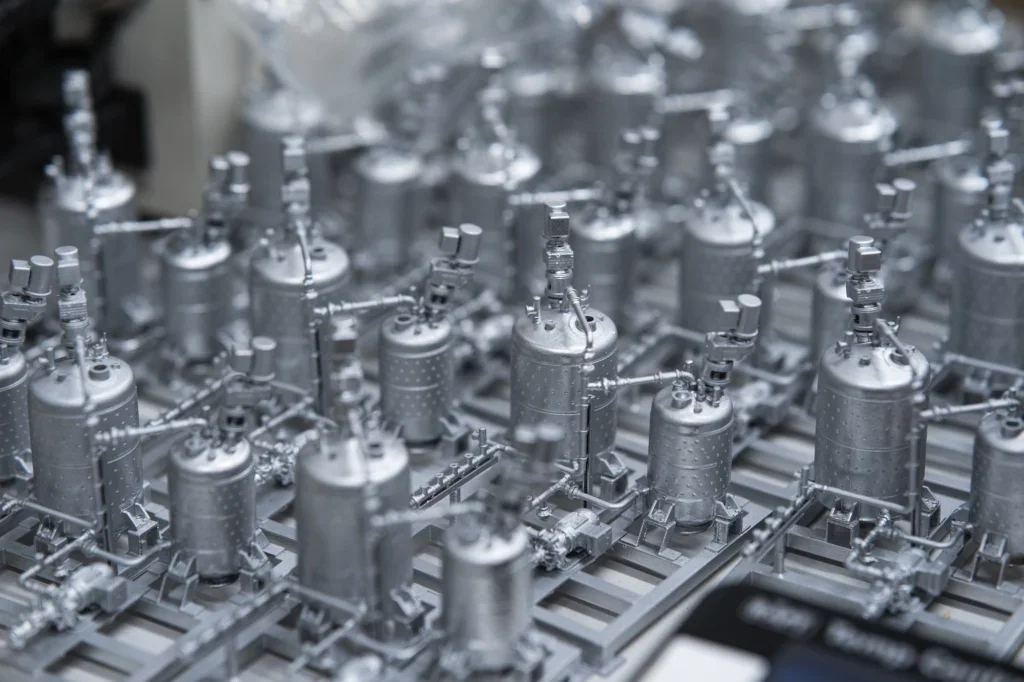
It also points to a healthy set of environmental and economic benefits: fewer trees felled, less CO2 and water needed in the maturation process, dramatically reduced production costs per bottle, and a higher yield for distillers thanks to a negligible angels’ share.
All of this sounds great on paper. However, it isn’t quite as revolutionary as it might sound.
Back in 2018, US-based inventor Doug Hall, founder of Eureka! Ranch in Ohio, developed Brain Brew Ventures, which used a similar technology it called “Time Compression,” accelerating the interaction of spirit and oak through the use of pressure. The company even partnered with Edrington (owner of The Macallan and Highland Park) to release Noble Oak, an American whiskey that, despite winning multiple gold medals in spirits competitions, has yet to set the world alight in terms of sales.
Similarly, in Stans, Switzerland, the Seven Seals distillery offers a patented method to accelerate maturation without “compromising on quality.”
Reactory’s punchy MO is “Decades of flavour, crafted in days.” It’s a bold claim, and one I recently put to the test in a tasting. This is where those claims get slightly more challenging.
Its sister company, Eltom Distillery, created Queen of Clubs Rum, which recently won a gold medal at the London Spirits Competition. Disappointingly, that wasn’t included in the sample pack the company sent, which instead contained a variety of single malt trials using a copper-pot-distilled malted barley distillate from New Zealand and different oak types – French and American – with various toasting and charring levels.

Each sample, I discovered after tasting, had been “aged” for a maximum of 28 days using Reactory’s tech and bottled at 60% ABV (120 proof).
With slight trepidation, I methodically dived in, trying each sample as I would any other whisky: neat, then with a small measure of water to dilute it and release certain compounds.
At this point, an opinion piece could go one of two ways – a sort of “Choose Your Own Adventure” into the future of single malt whisky. My immediate thought was one of positivity: is there something almost alchemic at work here? Yes, most definitely. My second thought was: “Why am I not enjoying this?”
We don’t necessarily drink single malt Scotch whisky simply for its flavor. As a spirit, it is perhaps the most extraordinary package of visceral and emotional stimulants one can find. We respond to flavor, texture, and age, but also to storytelling, people, place, and – perhaps most importantly – character and authenticity. It’s about how one experiences the whole package, not any one of these things in isolation.
“We respond to flavor, texture, and age, but also to storytelling, people, place, and – perhaps most importantly – character and authenticity.”
Neil Ridley
Alas, for me, while the samples were technically proficient and certainly drinkable, with a pronounced, extracted tannic oakiness, they lacked genuine depth – both the texture and the character that long maturation in oak almost certainly brings to the table.
Spirit character is something one can analyze and measure but never truly capture or understand. Read the recent excellent pieces by my fellow World of Fine Spirits columnist Millie Milliken on spirit texture and her ode to dirty distilleries, and you begin to realize that imperfections are often crucial components of our favorite aged spirits.
Sometimes it’s a happy accident – the waxy quality of Clynelish is said to come from fatty oil residue built up in a spirit-marrying tank – and sometimes it’s an unwillingness to compromise or move with the times: think of Springbank’s almost antiquated production methods, or the funk-laden dunder pits at Jamaica’s Hampden Estate.
And here’s the kicker with accelerating age: despite the impressive technological achievements, do we really need or want Rome to be built in a day?
To look at this from the current economic perspective for a second, the world is already awash with aged spirit. I touched on this back in February. The five leading global distillers have an estimated $22 billion of aged stock sitting in warehouses, including Scotch whisky, cognac, and tequila. The last thing the industry needs, unfortunately, is the ability to make more of it, faster.

From a more emotional perspective, the unbridled joy of opening a single malt is knowing that it has taken 10, 15, or 20 years to reach this level of perfection. That tenet feels like an unbreakable bond we have with certain dark spirits – one we shouldn’t mistreat or disrespect.
To many, age is a construct. In the health and beauty sector, global consumers spent an estimated $50 billion in 2024 alone trying to look younger: Botox, fillers, peptide-enriched lotions, infrared light masks, and age-defying supplements. I don’t doubt that the right combination of these things brings joy to those who subscribe to them (even I moisturize daily), but at the same time, wisdom and age, well etched into a craggy face or a broad, wrinkled smile, resonate in a far greater, more authentic capacity.
It was Mark Twain who rather fittingly pointed out that one should never complain about growing old: “It’s a privilege denied to many.” And he’s right.
Time gives us undeniable authenticity. Yes, that might be an old-fashioned way of thinking about it, but growing old gracefully holds a certain amount of romance, storytelling, and tradition. We live in a world increasingly filled with the drone of “I need it yesterday”; with tech that constantly requires updates; with products that are manufactured perfunctorily, not made to last.
Surely dark spirits must be the last bastion where time is something you simply can’t mess with.