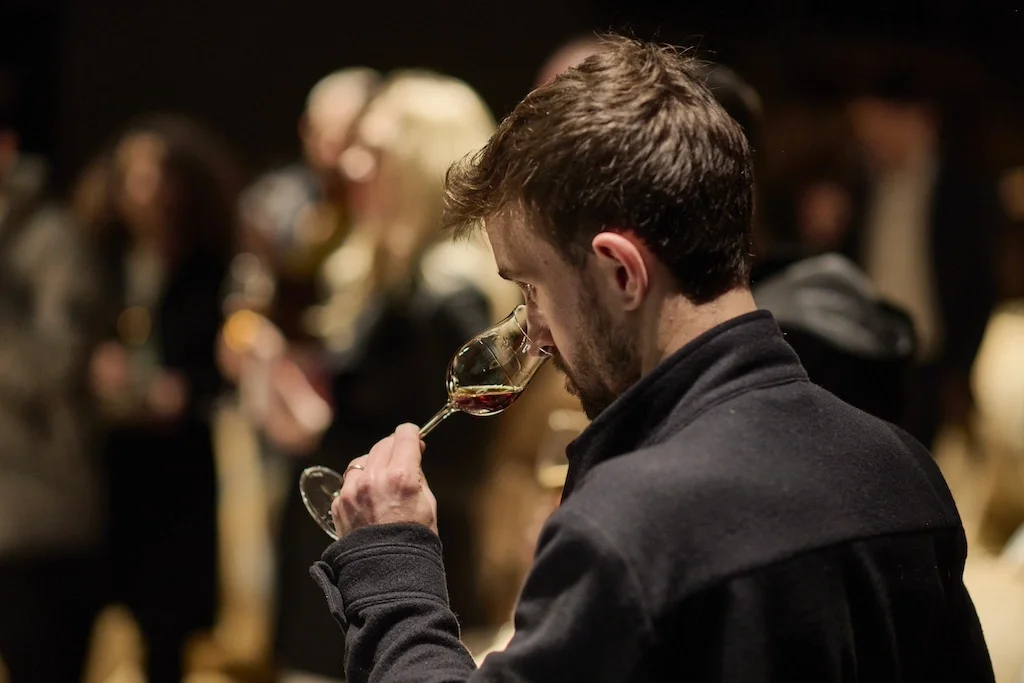
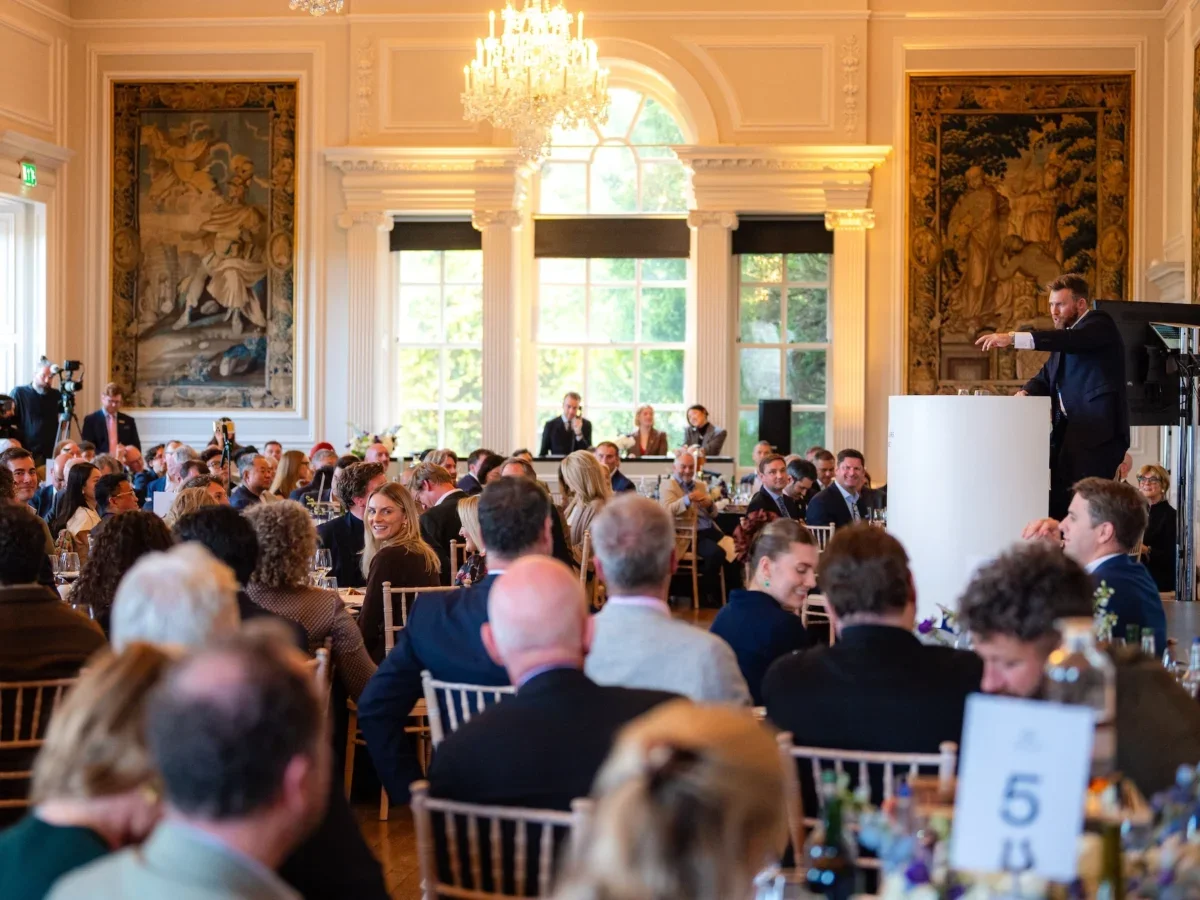
In the end, there was never anything to worry about. Nearly a week has passed since the Distillers One of One auction at Hopetoun House.
For a third time, expectations were surpassed, estimates exceeded, and serious money changed hands; £2.9m ($3.9m), to be exact.
That headline figure is only the start. Of the 39 brands that donated lots, 30 achieved new auction records. The total more than doubled the pre-sale high estimate, and once the buyer’s premium is set aside, the Youth Action Fund is £2.3m ($3.1m) better off. It’s a remarkable result by any measure, but to achieve it in a year colored by caution feels miraculous.
There’s no getting around the fact that the Scotch whisky market is not enjoying the same level of sales it saw in 2023, the last time this biennial auction was held. For some brands, the worst may yet be to come. But the greatest concern ahead of this third Distillers One of One was the secondary market, where transaction value has plummeted 48% year on year.
How to account for such a decline? One theory is that prominent collectors and investors have exited the market. Yet Jonny Fowle, global head of whisky at Sotheby’s, told The World of Fine Spirits that Scotch’s core spenders remain; they have simply been waiting for the right moment.
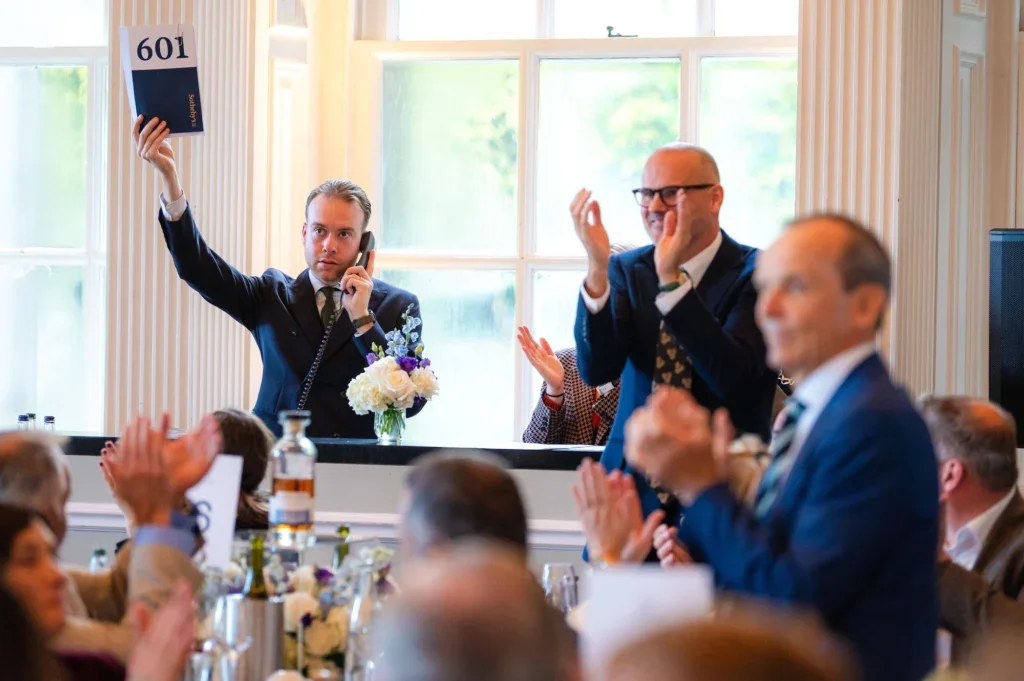
“I don’t think people’s interest has necessarily decreased,” he said before the auction. “I just think that the volume of stuff going into the market has increased, so it feels like people are less engaged. With a project like Distillers One of One, you see how many people are super interested and super keen, and for whom this is their main hobby. I think this will demonstrate the extent of the passion of the people who are still in the game, whereas maybe normal auctions have started to shine a light on how few people operate at a high end in this industry.”
You can see examples of Fowle’s theory throughout the market. The Glenlivet Spira 60 Year Old sold for £650,000 ($870,000) at Distillers One of One, while a whisky from the same distillery, just five years its junior, sold for £25,000 ($33,000) in June. There are, obviously, major differences: the decanter is more striking, the bottle comes directly from the distillery, and the auction’s philanthropic spirit justifies higher bids.
But the result also highlights how much Scotch’s biggest collectors value rarity. There is just one Glenlivet Spira, whereas 100 bottles of The Glenlivet 55 Year Old exist. For today’s collector, 100 bottles is simply too many to justify an ultra-premium price tag. Throw a unique bottle into the mix, and all bets are off; they’re not only willing to spend but spend big.
“Collectors are always looking for something that others either don’t have or can’t get and this is an example of the way in which genuine scarcity motivates buyers.”
Jonny Fowle
Take the spectacular Port Ellen Prism, which sold for £375,000 ($500,000), as another example. Compare it to Port Ellen Gemini, which recently sold for £20,000 ($27,000) at auction. The same differentiators exist, but there’s little to separate the liquid on paper. Both were drawn from 1978 casks, and Gemini is just two years younger (44 years vs 46 years). But there is only one Prism and 274 Geminis.
For Fowle, there are lessons to be learned from the result. “This should encourage brands to think outside the norm,” he said, speaking after the auction. “Crazy concepts, large formats and high age statements that don’t necessarily adhere to their usual iconography or messaging.
“Add to this the fact that the bottles are truly rare. Collectors are always looking for something that others either don’t have or can’t get and this is an example of the way in which genuine scarcity motivates buyers.”
This all serves to strengthen Distillers One of One’s founding principle: that every lot is unique and unrepeatable. That alone should prove its viability even if the wider industry continues to struggle. A fourth in 2027 now feels inevitable, but hurdles remain.
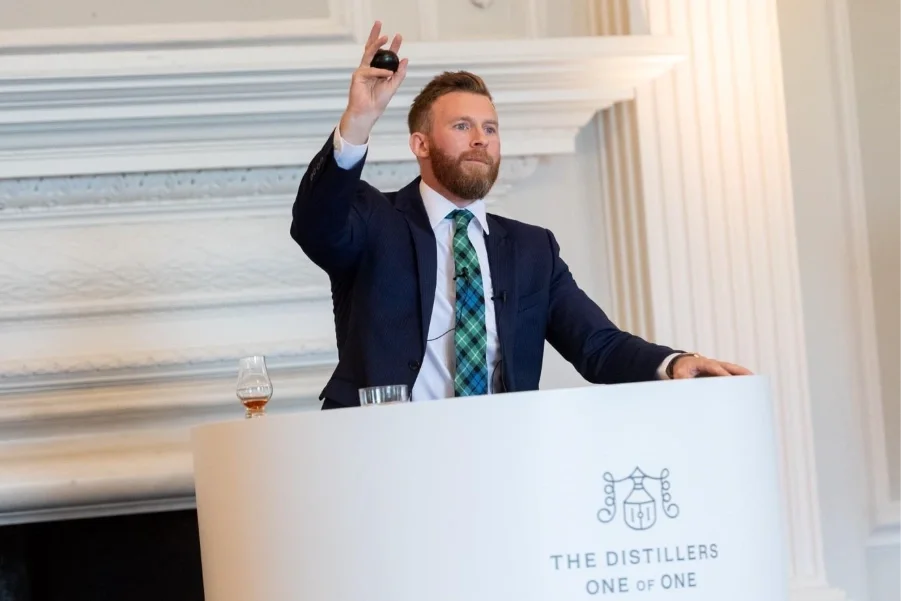
The original agreement between Sotheby’s and the Worshipful Company of Distillers is up for renewal. That shouldn’t be a difficult conversation once Sotheby’s collects its 25% buyer’s premium. The main challenge may prove to be the donors, where revenues continue to stall and fall, and where boardrooms are scrutinizing discretionary spending, including charity.
Beanie Epsey, the managing director of the auction, is feeling optimistic. She told The World of Fine Spirits: “Having taken inspiration from other charity wine auctions with long histories, we’ve always aspired to create a Scotch whisky auction series with the same longevity. We want to celebrate our craftspeople and give back to our communities over the long term.
“No question it has been a challenging year, but we have always believed in the power of the Distillers One of One not just as a philanthropic platform, but also as a platform to showcase the very best of Scotch whisky. At this point in time, there’s no reason to believe that we won’t have an auction in 2027 and there’s no reason to think we won’t have another fantastic assembly of lots. The fact that so many donors are already talking about 2027 bodes well.”
Significant Sales
Ladyburn, One of One 2025 Marilyn Monroe by Sam Shaw
Estimate: £30,000 – £50,000
Lot sold: £225,000
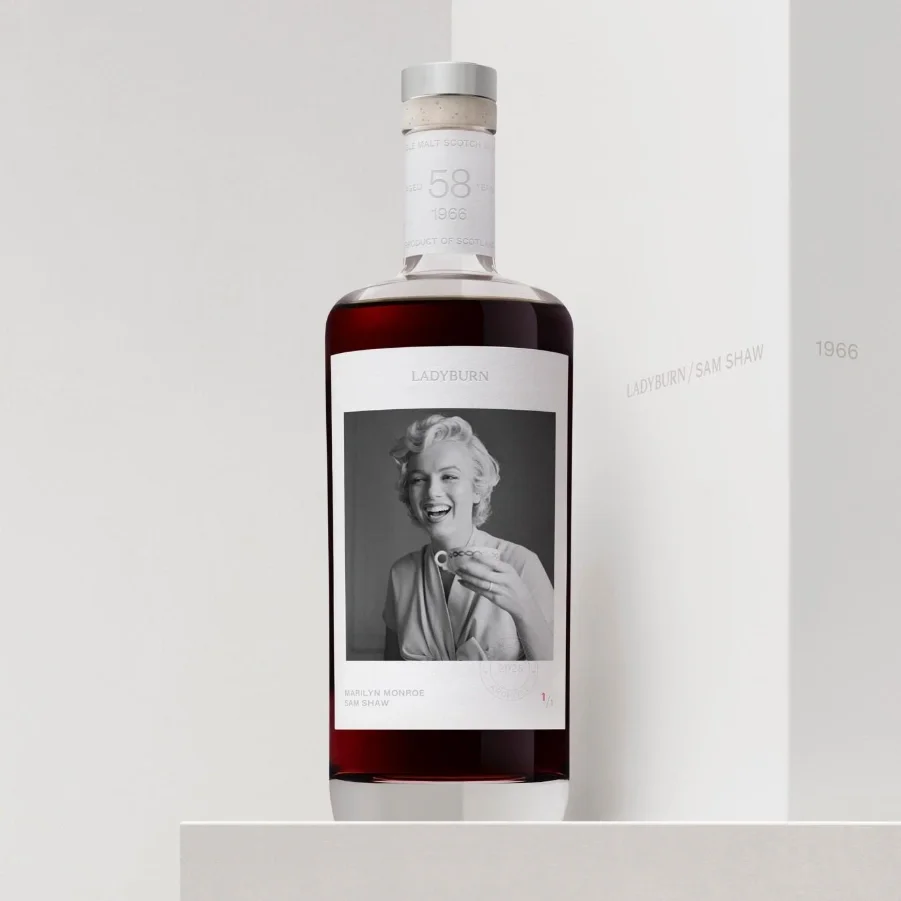
Ladyburn is an oddity in the annals of Scotch whisky history, operational for just nine years between 1966 and 1975. Very few casks remain, particularly from 1966. That rarity would have been a major draw for buyers, as would the whisky’s treacle-like color. But the key selling point was the label, which featured a rare photograph of Marilyn Monroe taken by Sam Shaw. It’s a candid shot of Monroe drinking tea at the St. Regis New York in 1954, the peak of her fame.
Then again, if you love the image, you can license it from Getty Images for around $1,000. Fowle points to this as being the most surprising result of the day, saying: “I think the Ladyburn stole the show in terms of being the most unexpected. This was very similar to their 2021 bottle (David Bailey x John Lennon), but the price increase here was certainly more than anybody anticipated.”
The Glenlivet, Spira 60 Year Old
Est: £60,000-£110,000
Sold for: £650,000
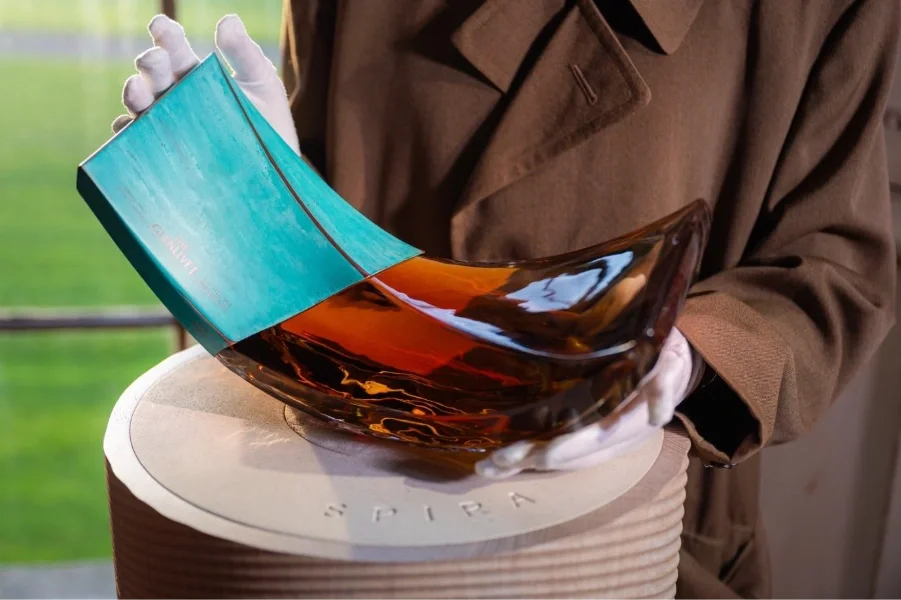
Always tipped to be the highest seller of the auction, The Glenlivet Spira is the most striking decanter of the 39 lots, with a wave design inspired by new-make spirit swirling around a copper still. Its enchanting form means the base sits higher than the neck, creating the illusion that the liquid flows uphill. Inside is the oldest whisky ever released by the distillery, though not the oldest Glenlivet overall. That distinction belongs to Gordon & MacPhail’s recently released Artistry in Oak 85 Year Old, the oldest Scotch whisky ever bottled. That didn’t seem to bother the winning bidder, though.
Port Ellen, Prism
Est: £150,000-£300,000
Sold for: £375,000
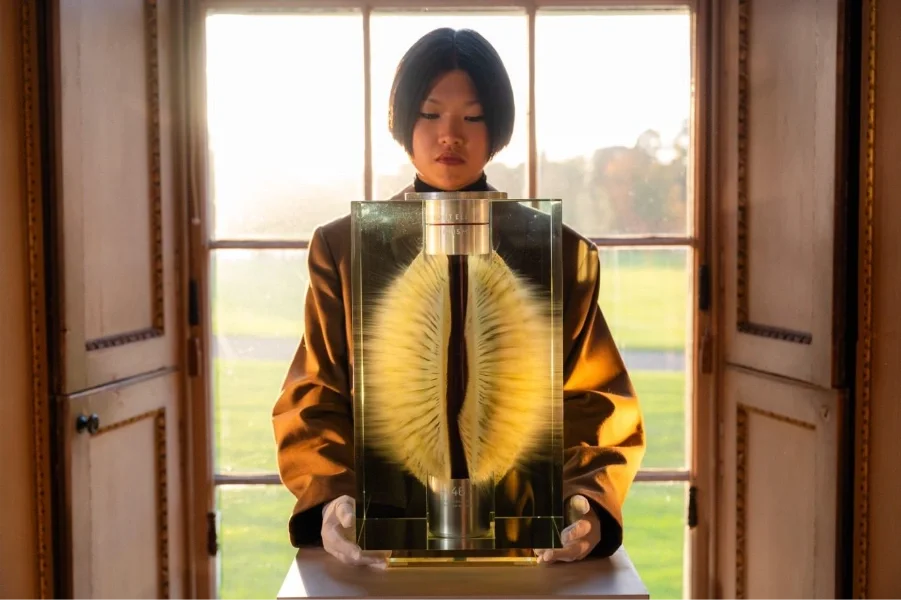
Port Ellen Prism is a visually arresting glass structure designed by artist Wilfried Grootens. The piece comprises multiple layers of hand-painted glass, creating the effect of smoke rising from the central canister. At 46 years old, the whisky inside is the oldest ever released from Port Ellen. A final flourish: the sculpture weighs 200 lbs.
The Glen Grant, Eternal
Est: £80,000-£120,000
Sold for: £400,000
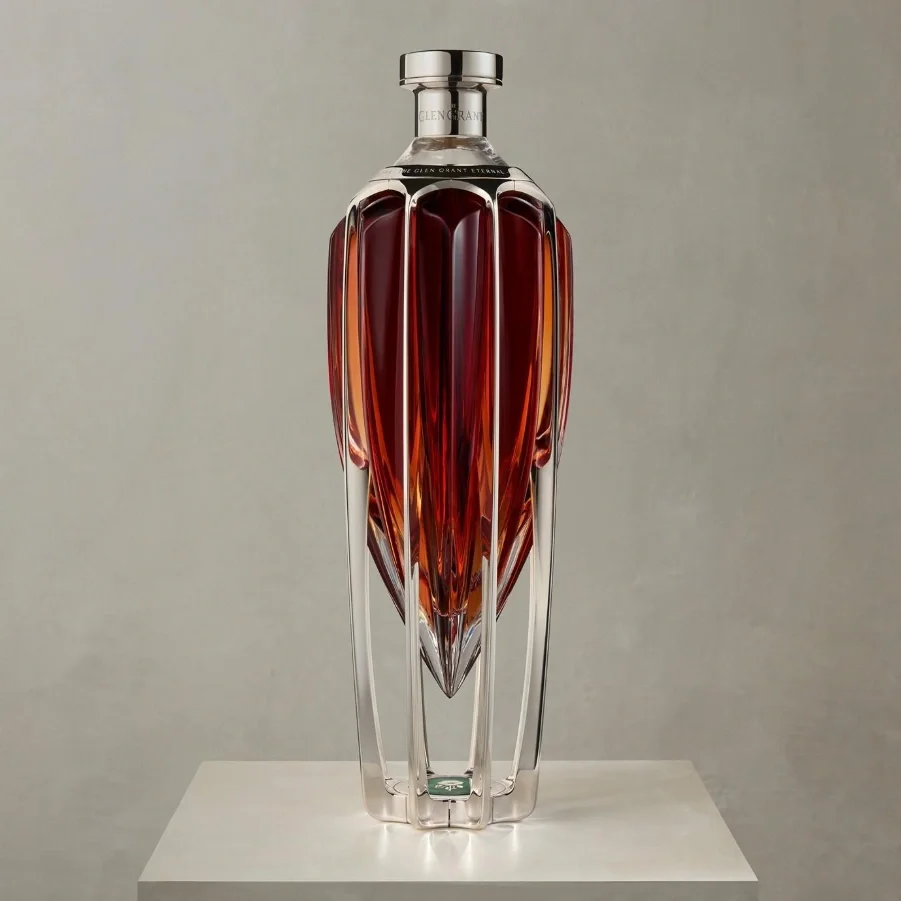
The Glen Grant Eternal is not only a beautiful decanter but a surprisingly practical one, being little larger than a standard bottle. Inspired by a seedpod preparing to open, it pays tribute to the distillery’s Garden of Splendours. The glass vessel appears to grow around its silver cage, like an oak tree enveloping a metal fence, a metaphor for the whisky’s slow evolution in cask. Inside is another record-breaker: a 77-year-old distilled in 1948, the oldest of all 39 lots.
Laphroaig, Capsule
Est: £40,000-£80,000
Sold for: £125,000
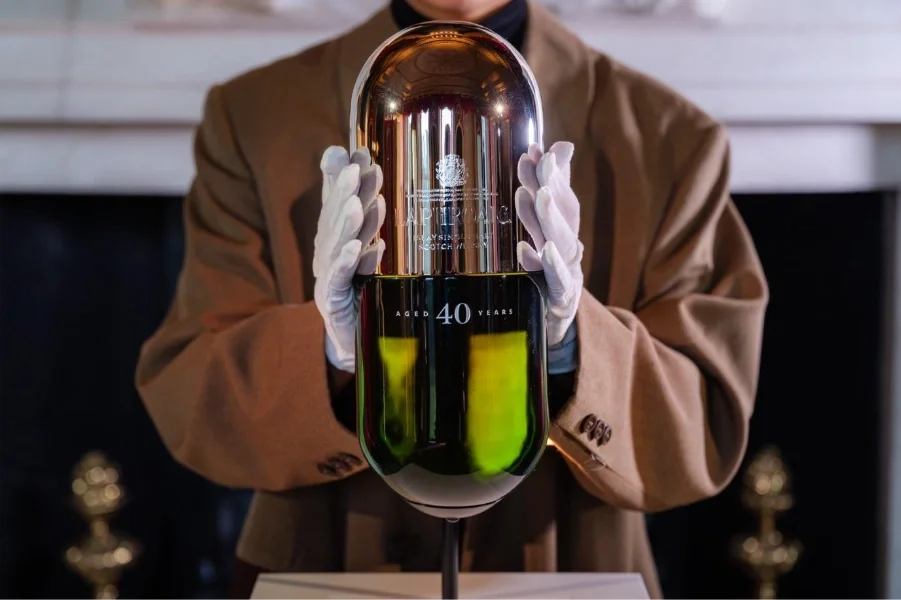
Laphroaig has never shied away from its distinctive flavor profile of tar, welly boots, and TCP. While the distillery is quick to clarify that it has no medicinal properties, that association remains an indelible part of its story. During Prohibition, Laphroaig continued exporting to the United States under licence for medicinal use, its iodine-rich spirit fitting the bill perfectly. Medicine has thankfully moved on since then, and the brand didn’t draw a connection between this pill-shaped decanter and that curious chapter of its past. But the reference wasn’t lost on observers, nor on the winning bidder, who paid more than three times the low estimate to take it home.