When it comes to vintage spirit cocktails, leaving the mixing to the world's leading bartenders is undoubtedly prudent, but these ethereal bottles are not as far from your reach as you may think.
Far from having to be an astronomically expensive pursuit, with patience, fortuitous timing, and a bit of cautious research, acquiring bottles from the past to have some fun with can actually be surprisingly attainable.
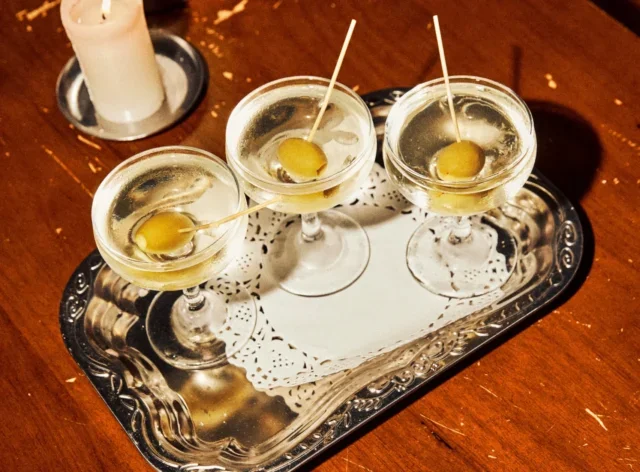
That’s where a trusty auction house comes into its own. Over vintage Silver Bullets, Negronis, and Last Words (not to forget 1950s Fernet Pedroni & Cokes) at Soho’s Henson’s Bar, we sat down with the head of Whisky.Auction, Gemma de Jesus, and a selection of some of the houses’ most time-bending gins, amaros and liqueurs – from 1970s Gilbey’s Gin and 1960s Campari, to 1980s Kummel and 1970s/1980s green Chartreuse Tarragona.
“It’s like travelling through time,” she says of the category. “It’s easy to fall in love with the romance and surprise of vintage spirits.” De Jesus certainly has her favourites too when it comes to good value – Benedictine, Teacher’s whisky – while Chartreuse, she says, is a real connoisseur’s liqueur.
What was most alarming, though, were the estimates of some of these bottles when bought at auction compared to off the shelf. While the Campari, unsurprisingly, can go for around $250-$450 a bottle, the Gordon’s could be yours for just $25 (less than one sat on a supermarket shelf today), or the Gilbey’s is also a snip at $40. Sure, that green Chartreuse might set you back $800, but a bottle of the Kummel could only be $80, or the Ramazotti, only $15.
How some of these liquids present in cocktails today was alarmingly vivid. That Kummel in a Silver Bullet was still bright, herbaceous, and intriguingly smoky after 50 years, while the combination of the 1960s Campari and a 1960s Ramazotti amaro made our vintage Negroni less bitter, more rounded, and noticeably richer in texture. A real treat, though, was the old green Chartreuse in the Last Word – less herbaceous and sweeter than its modern counterparts, this was a true glimpse into the evolution of one of the liqueur world’s most sought-after golden eggs.
A category De Jesus is particularly excited about when it comes to quality and value is tequila. While most buyers will still be looking to the more traditional ones for their vintage collection – gin, whisky – the agave spirit (especially bottles from the 1970s, a turning point in tequila’s production arc) is proving to be exceptionally competitive when it comes to the purse strings.
At the point of writing, a Sauza Conmemorativo 1873-1978 went for $90, while an Ole is sitting at just $50 (both were bottles in the 1970s). As tequila’s star continues to grow, now might be the best time to get your hands on some bottles.
Recipes to try at home
Silver Bullet
Ingredients
– 45ml 1970s Gordon’s Gin
– 20ml 1980s Kümmel
– 10ml lemon juice
Method: Shake over ice and strain into a chilled coupe
Vesper Martini
Ingredients
45ml – 1950s Plymouth Gin
15ml – 1960s Triumph Czechoslovakian vodka
10ml – 1956 Kina Lillet
Method: Shake over ice and serve without lemon peel (with the lemon zest expressed over the drink)
Negroni
25ml – 1970s Gordon’s London Dry Gin American import
25ml – 1970s Campari
25ml – 1970s Martini Rosso vermouth
Method: Stir down over ice and serve over a large ice cube with a wedge of freshly cut orange
Top tips when buying vintage spirits
– Buy from a reputable source who will have verified authenticity and valued them accordingly, although quality is always a bit of a Russian roulette.
– Look at cocktails that perhaps aren’t particularly fashionable at the moment – the vintage versions of their parts will be much better value.
– Don’t always think about mixing liquids all from the same decade (aka 1950s gin, with 1950s Campari, and 1950s sweet vermouth. Just buy what is best.
– Consider the fill level and how ‘oxidised’ the bottle may be. Vintage spirits will lose ABV over time, having been exposed to air and sunlight, so they might not be as punchy as a fresh bottle. However, bear in mind that a lot of the vintage charm can come from bottle-aging.
– Don’t think about investment when it comes to vintage. Always open the bottles you get your hands on – they’ve been closed long enough.