If you've ever had the privilege of visiting the surprisingly sleepy town of Cognac during the sizzling summer months, you'll be familiar with its curious quirks.
The quaint boulangeries that never seem to be open, the curious, nondescript shuttered doorways of faded limestone buildings, the buzzing little tabacs and, of course, the lifeblood spirit which takes its name from the town. For centuries, Cognac has embodied French elegance like no other: the chic Louis Vuitton handbag, compared to the rustic, weather-beaten, aged leather satchel, which charmingly represents the country’s other rustic spirits: namely Armagnac and Calvados.
The reason for such sleepiness has been magnified to alarming proportions over the last few years. Indeed, the blazing, oppressive heat and clear azure skies during July and August create both an idyllic, bucolic backdrop for the Grand Champagne region’s neatly terraced Ugni-blanc grape vines – but also a vaguely existential challenge for the cellar masters and winemakers.

With smaller berries, earlier harvests, and diminishing yields, creating first-class Cognac is becoming increasingly difficult: a balancing act between the alchemy of blending, a greater respect for oak maturation, and a deeper understanding of the noble grape. To thrive in such an environment is a monumental achievement: yet one that is slowly becoming a perilous existence given the apparent effects of climate change. Still, however, it endures and overcomes.
In Grand Champagne, there are few brands which have come to represent the finely tuned craft of aged Cognac more so than Rémy Martin’s Louis XIII. Arguably the vanguard of blending ultra-aged eaux-de-vie, its spiritual home is the highly secretive cellars of the Le Grollet estate and although one can visit for a private tour (€1,500 per person), the most prized cellar – honoring its former president, André Hériard Dubreuil, is off limits. This aging paradise is split across three levels, each with a significantly distinct change in temperature and humidity.
Visiting in mid-July, the cellar offers a most welcome respite from the perilously dry, 105-degree heat outside. As one descends further into its hidden subterranean depths, first lined with Limousine oak casks, aged between 40 and 50 years, then deeper, past the mysterious unmarked demijohns, it feels detached from both the elements and from time itself.
A sort of spiritual stasis, reserved for only the most highly revered ‘tierçon’ casks (vessels used to bring together a complex blend of hundreds of different aged eaux-de-vie, rather than simply aging mature spirit), and a playground for cellar master, Baptiste Loiseau. It is here that Louis XIII slowly begins to take shape: an assemblage of aged eaux-de-vie, each one with its own DNA, personality, and character.

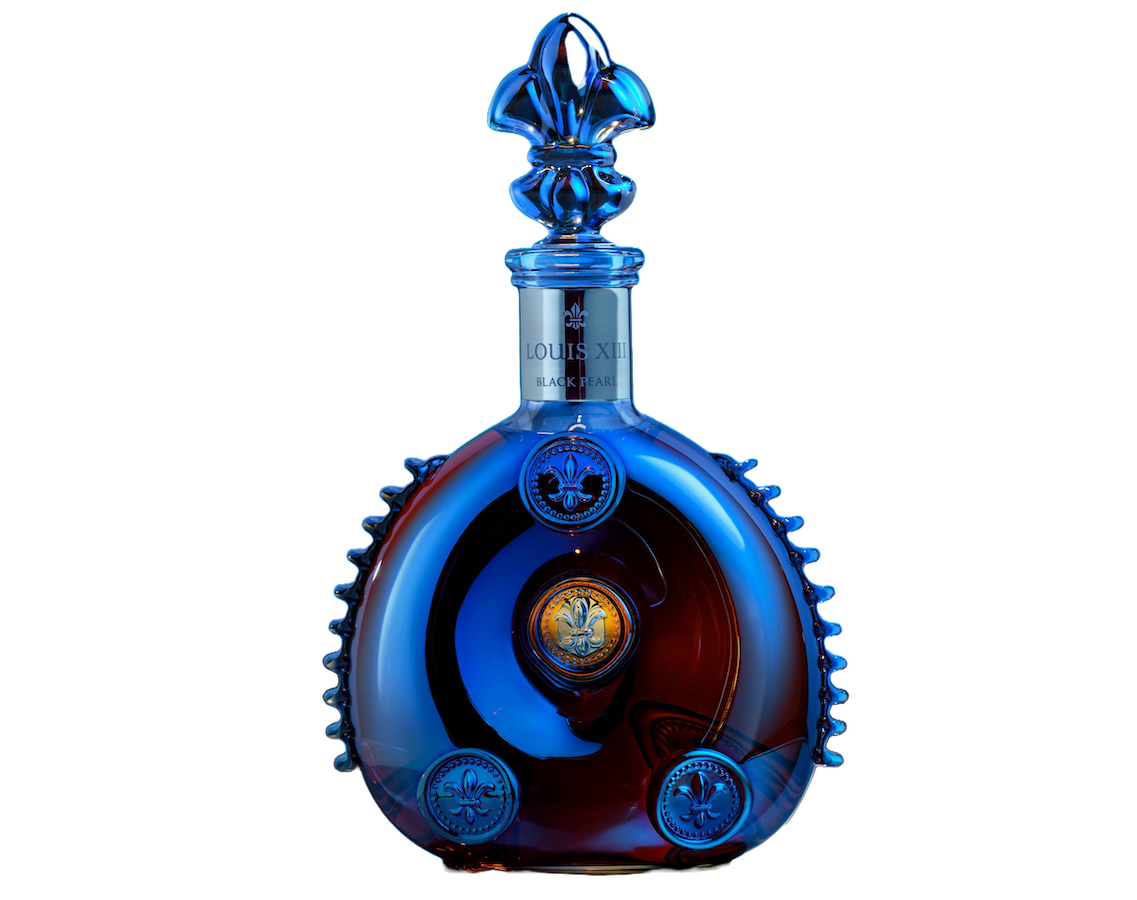
However, today’s visit takes us even further into the depths to explore the very oldest, most fragile tierçon casks, some residing untouched since 1917. Welcome to the territory of Black Pearl: a highly limited expression project, which Loiseau describes as “a recreation of the sensation and experience when you are tasting Louis XIII directly in these hallowed cellars.”
The original Black Pearl release was launched in 2007, capturing the essence of a specific tierçon cask, selected by the previous cellar master, Pierrette Trichet. Two releases followed, one in 2014 and another in 2019.
These releases explore how aged eaux-de-vie can be used as top-dressing: building blocks of flavor within a broader, more textured Louis XIII blend, from those which exhibit specific fresh citrus notes, aromatic woods, or leather and spiced notes, to richer honey, nuttiness, or well-rounded red fruit. They also celebrate the unique environment that binds them together: the cellar.
For the latest Black Pearl release, Loiseau explores this concept further. “For me it was about bringing out the earthy notes, precious woods, forest floor, and patchouli notes,” he says. “I was really looking for a distinct eaux-de-vie that transported me to the experience which you can only have here at the cellars in Le Grollet – a raw authenticity.”

The eaux-de-vie in question was found in a demijohn (likely introduced from the era when cellar master George Clot was at the helm and further nurtured by his successor, Pierrette Trichet), but it had dipped below 40% ABV. However, once introduced into the final Louis XIII ‘singular’ blend in the tierçon cask, it began to show its true potential.
In many respects, the new edition represents a true handshake between three generations of cellar masters – and the location that has defined its complexity. To celebrate this aspect further, the team has created what it describes as a ‘first-of-its-kind tasting ritual’ that attempts to replicate the natural conditions of the Le Grollet cellars, allowing the blend to be experienced by consumers in the same way as it would be by Loiseau down in the subterranean depths.
Each decanter is presented in its very own “bespoke cooling cellar”, a temperature-controlled presentation box that allows the liquid to rest at a minimum of 13°C (55.4°F). As it warms in the glass, the flavors develop and open up, heightening the more delicate aromas further. “For the first time, we brought the experience of the cellar beyond its walls, with this singular blend and its exclusive temperature-driven ritual,” explains Ludovic du Plessis, director of Rémy Cointreau Prestige Division.
So, what does this current edition of Black Pearl taste like, fresh from its chilly housing, in a frosted crystal glass? More to the point: does it mirror the characteristics I experienced in the subterranean depths?

As the serve arrives at 13°C (55.4°F), there are initial aromas of beeswax, honey, sandalwood, and patchouli, alongside a distinct earthy dryness. It’s delicate, but slightly closed, with a touch of polished rosewood. As the glass slowly warms up, the more complex aromas begin to unveil themselves: warm spices – a touch of cinnamon, clove, and nutmeg, then whispers of milk chocolate and dried mango. Finally, you’ll find gentle floral notes – white flowers and orchard blossoms revealing themselves as the temperature rises further.
In short, yes, the experience does help the palate to connect to a broader sense of the place, which has played host to such a revered liquid for decades.
Whilst I am usually cynical of such gimmickry, there’s something wonderfully absurd about this package: to attempt to bring the liquid alive in such a fashion is worthy of a wry smile and brings into focus the importance of temperature throughout the process of creating a world-class Cognac.
It’s also interesting to note is that Remy Martin is no stranger to highlighting the challenging aspects of production in an ever-changing climate. Back in 2017, the brand partnered with US producer and songwriter, Pharrell Williams, to develop the ‘100 Years’ concept: a song entitled “100 Years: The Song You’ll Only Hear If We Care”, which was pressed onto a single record, made not from traditional vinyl, but from the clay found in the Grand Champagne region and stored in a safe at the brand home, not to be played until the year 2117. The main premise here being that, if sea levels continue to rise at the rates predicted, the cellars would be flooded, destroying the record forever.
A strictly limited number of decanters are available for an SRP of $28,000 through the LOUIS XIII network of private client directors.